April 8, 2026 • Dale Merrick • 9 min reading time • Prices verified June 5, 2026
DIY Fuel Injector Tester and Cleaner Kits: What the $22–$135 Tools Actually Diagnose
Fuel injectors are the tiny electronically controlled valves that spray a precise mist of fuel into your engine. When one starts misfiring, clogging, or leaking, you feel it: rough idle, hesitation when accelerating, a check-engine light, or a fuel-economy number that quietly slides in the wrong direction. For most of automotive history, diagnosing a bad injector meant a shop visit, a labor bill, and a lot of guesswork. Today there is a full tier of DIY kits — ranging from a $22 noid light set to a $135 flow-and-pulse tester — that let you gather real diagnostic data at home or on the bench of a small shop. This article walks you through exactly what those kits do, what they cannot do, and how to make the right buy decision given your vehicle type, symptom pattern, and how deep you actually want to go.
| EDITOR'S PICK[CMTOOL Fuel Injector Cleaner Kit](https://www.amazon.com/dp/B0CD1J1SQZ?tag=greenflower20-20) | Mid-tier[EM276SET Fuel Injector Tester](https://www.amazon.com/dp/B07VC37VRB?tag=greenflower20-20) &… | Budget pick[Universal Fuel Injector Tester](https://www.amazon.com/dp/B0CNH5P66F?tag=greenflower20-20)… | |
|---|---|---|---|
| Pulse modes | — | — | 8 |
| Reservoir capacity | 1000ml | — | — |
| Non-dismantle use | ✓ | — | — |
| Included adapters | — | — | 8 sizes |
| Voltage output | — | — | 12V/5V |
| Dual injector support | — | — | ✓ |
| Price | $79.99 | $28.49 | $26.89 |
| See on Amazon → | See on Amazon → | See on Amazon → |
The Diagnostic Ladder: From $22 Noid Lights to $135 Bench Testers
Think of DIY injector tools as a ladder. Each rung adds information — and cost. Understanding which rung answers your specific question is the whole game.
Rung 1 — Noid Light Sets ($22–$35). A noid light is a small plug that substitutes for the injector connector and flashes when the ECU (engine control unit — the car’s main computer) is actually sending a voltage pulse. That’s it. It answers one binary question: Is the injector circuit getting a signal? If the light doesn’t flash, your problem is upstream — wiring, connector, or ECU output. If it does flash, the injector itself, fuel pressure, or fuel volume is the culprit. As Underhood Service’s guide on injector diagnostics notes, confirming signal presence first eliminates roughly a third of apparent “injector failures” that are actually wiring faults. For $22–$35, a quality noid set covering domestic, import, and multi-port sizes is the single highest-ROI diagnostic tool on this list.
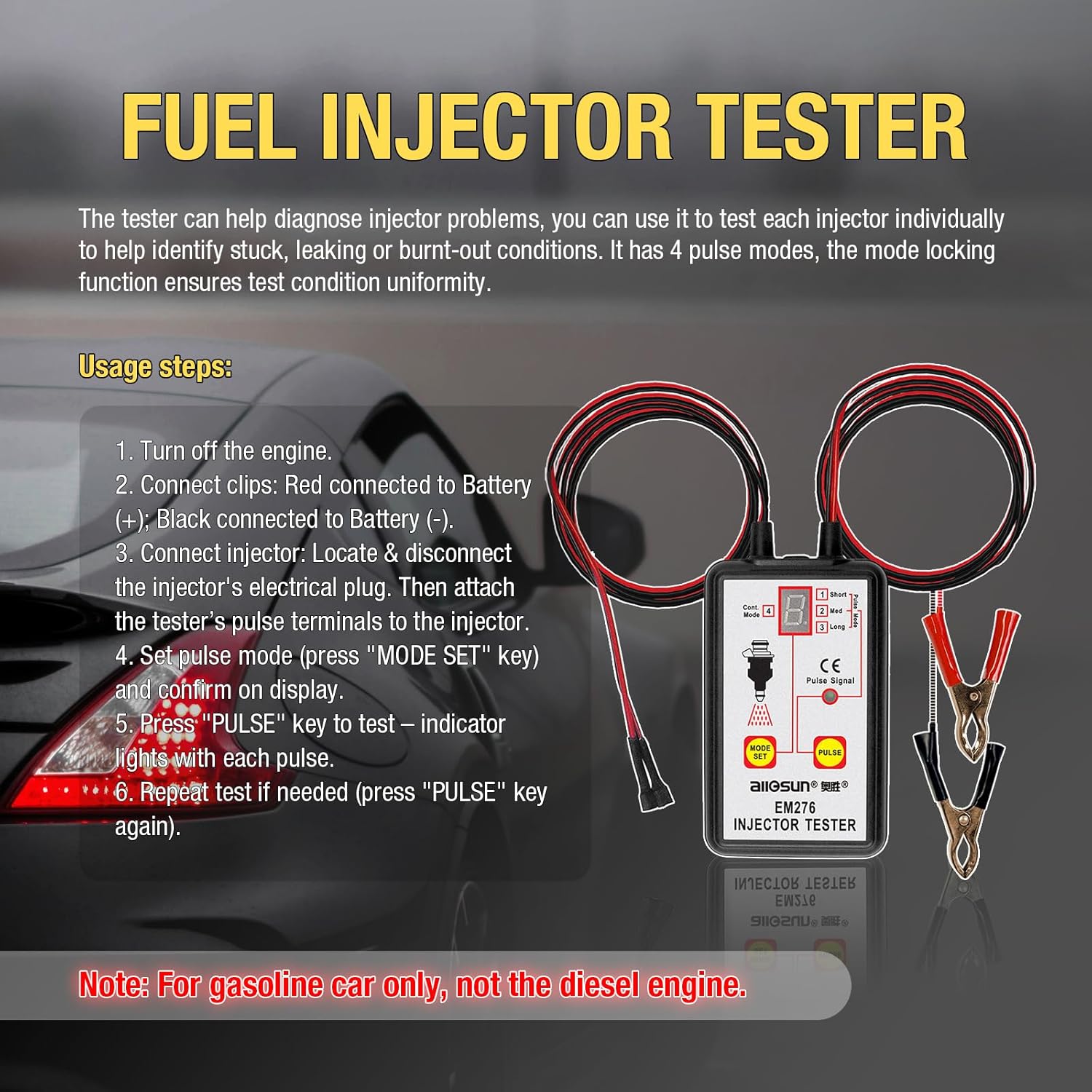
Rung 2 — Injector Pulse Testers ($30–$55). One step up, these handheld units send a controlled electrical pulse directly to the injector solenoid (the electromagnet inside the injector that opens the valve). You hear or feel the injector click. This tells you the solenoid coil isn’t shorted or open-circuit — a mechanical confirmation that’s impossible with a noid light alone. Motor Age’s injector balance testing explainer specifically calls out solenoid-click verification as a fast, no-equipment triage step before committing to bench testing. Most of these units are also sold as “noid + pulse” combos; at $40–$55 for a combo kit, that’s the sweet spot for someone doing one-off diagnosis.
Rung 3 — Resistance and Balance Testers ($45–$80). These add a multimeter-style resistance check to the pulse function. A healthy port-injection (PFI) injector typically reads 11–17 ohms; a GDI (gasoline direct injection — a newer engine design where fuel is sprayed directly into the cylinder) injector reads 2–3 ohms. Out-of-spec resistance narrows the failure to the solenoid winding itself. Some kits in this range also include a rudimentary “balance” mode: pulse all injectors sequentially and watch for the one that causes the least RPM drop when disabled, pointing to low flow.
Rung 4 — Flow and Spray Pattern Testers ($90–$135). This is the ceiling of the true DIY category. These bench-top rigs connect the injector to a small pump and reservoir, pulse it at a calibrated rate, and collect the output in graduated cylinders. You can compare flow volume between injectors and — more importantly — observe spray pattern. A healthy injector produces a fine, symmetric cone. A partially clogged injector produces a stream, a blob, or an off-axis spray. Per the SAE technical paper on injector deposit formation (2019-01-0263), asymmetric spray patterns are strongly correlated with combustion chamber hot-spots and localized carbon deposits — a finding that makes pattern observation genuinely diagnostic rather than cosmetic.
What These Kits Cannot Tell You (And Why It Matters)
Here is where honesty earns its keep. The $22–$135 range has real limits, and conflating what these tools show with what a professional flow bench shows is how people misdiagnose engines and spend money on the wrong fix.
Flow accuracy is limited. A $135 DIY flow tester uses a low-pressure shop pump and gravity-fed graduated cylinders. Injectors in your engine operate at 43–65 PSI on a port-injection system and 1,500–2,500 PSI on a GDI system. The DIY bench runs at roughly 30–45 PSI. Flow numbers at low pressure do not linearly scale to operating pressure — they give you a relative comparison between injectors on the same car, not absolute flow rates. Engine Labs’ coverage of GDI carbon buildup emphasizes that GDI injectors should be professionally flow-tested under high-pressure conditions before any clean-and-return decision is made.
Spray pattern at low pressure differs from spray pattern at operating pressure. Pattern observation on a DIY bench is still useful for catching catastrophically clogged or leaking injectors, but a marginal pattern issue at 35 PSI may disappear or worsen at 2,000 PSI. Treat it as a first-cut filter, not a final verdict.
No leak-down or return-flow data. Professional testers check whether the injector seals fully when un-pulsed (a leaking injector floods the cylinder at idle). DIY kits in this price range generally don’t isolate leak-down; you can infer it from pooling fluid in the catch cylinder, but it’s not a controlled measurement.
GDI injectors are a special case. Popular Mechanics’ overview of fuel injector failure modes notes that GDI injectors typically fail differently than PFI injectors — coking and deposit formation at the tip are the dominant failure mode, and the internal fuel path sees dramatically higher pressures and temperatures. A noid-light or pulse-tester diagnosis is still valid for GDI (the signal circuit is the same); but flow and pattern testing on a DIY bench is less reliable for GDI because of the pressure delta. If you’re chasing a GDI misfire, professional ultrasonic cleaning combined with a high-pressure bench test is a better diagnostic path than DIY flow testing alone.
By the Numbers: Price Tier vs. What You Actually Learn
| Kit Type | Price Range | Confirms Signal | Confirms Solenoid | Relative Flow | Spray Pattern |
|---|---|---|---|---|---|
| Noid light set | $22–$35 | ✓ | ✗ | ✗ | ✗ |
| Pulse tester (solo) | $30–$45 | ✗ | ✓ | ✗ | ✗ |
| Noid + pulse combo | $40–$55 | ✓ | ✓ | ✗ | ✗ |
| Resistance / balance kit | $45–$80 | ✓ | ✓ | Rough only | ✗ |
| Flow & spray bench | $90–$135 | ✓ | ✓ | Relative ✓ | Low-P ✓ |
The Cleaning Side: What $22–$135 Kits Can and Can’t Clean
Some kits in the $55–$135 range double as on-car or bench cleaners. Understanding the mechanism matters before you buy.
On-car flush adapters connect an aerosol can (or a pressurized cleaning canister) to the fuel rail — the pipe that feeds all injectors simultaneously — and disable the in-tank fuel pump while the cleaner runs through the system. The engine runs on solvent rather than fuel for a few minutes. This is similar in chemistry to running a concentrated liquid additive, but more direct: the cleaner contacts the injector tips without dilution. The active chemistry in reputable cleaning solvents is PEA — polyetheramine — a detergent that dissolves the soft, waxy deposits that form in PFI injectors. Per the SAE paper cited above, PEA-based chemistry is effective against the carbon-varnish deposits most common in port-injection engines.
Bench-top pulse-and-flush rigs cycle cleaning solvent through the injector while it’s pulsed open, combining mechanical agitation (the solenoid opening and closing) with chemical dissolving action. Operators in long-run shop reviews consistently note that this method is more thorough than on-car flushing for moderately clogged injectors, because the injector is isolated and fully exposed to solvent rather than competing with the fuel supply.
What neither approach handles: hard, baked-on carbon at GDI injector tips and on intake valves behind GDI cylinders. That carbon is the product of hot oil vapor and combustion gases baking against metal that never sees fuel wash — because GDI sprays fuel directly into the cylinder, not the intake port. Engine Labs’ coverage of GDI carbon buildup is unambiguous on this point: PEA chemistry in either on-car or bench-flush form cannot reliably dissolve baked GDI tip carbon. That application calls for ultrasonic cleaning (which uses high-frequency sound waves in a liquid bath to physically dislodge deposits) or walnut-shell media blasting of the intake ports. Both are shop-level procedures, not $135-kit territory.
Decision Framework: If X, Then Y
If you’re parked in front of a symptom and a credit card, here’s the clean decision tree:
If you have a misfire code and don’t know whether it’s electrical or injector: → Buy the $40–$55 noid + pulse combo first. This answers the question in 10 minutes without any disassembly.
If you’ve confirmed signal and solenoid function and still suspect a clogged injector: → The $90–$135 flow-and-spray bench tester gives you relative flow data that will tell you which cylinder is low. On a PFI engine, this is actionable. On a GDI engine, use it only as a first-cut filter, and plan for professional service if the data points to an injector.
If you’re running a small shop doing 3–8 fuel system services per month: → The DIY tier starts to feel cramped quickly. The $90–$135 bench is useful as a triage step before professional ultrasonic cleaning, but the per-unit cost math of a dedicated ultrasonic rig ($300–$600 entry-level professional units) justifies itself at roughly 15–20 injector sets per year. Motor Age’s injector testing overview frames this threshold explicitly: DIY bench testing makes economic sense for the enthusiast; shop economics favor dedicated equipment.
If your vehicle is a late-model turbocharged GDI engine (think post-2012 VW TSI, BMW N55/B58, Ford EcoBoost, GM LTG): → Noid and pulse testing: yes, absolutely. Flow bench at the DIY tier: limited value. Chemical flush kits: treat them as maintenance chemistry, not a cure for existing heavy deposits. The honest path for confirmed GDI carbon issues is professional ultrasonic cleaning of the injectors and walnut blasting of the intake ports — both of which are downstream of any DIY kit diagnosis.
If your budget is $22 and you’re not sure: → Start with the noid light set. A large share of apparent injector failures turn out to be connector and wiring faults that a $22 noid light catches before anyone buys a $200 injector. That’s the whole argument for the bottom rung of the ladder in one sentence.
The tools in this range are honest and useful when used within their limits. They’re not a replacement for a professional flow bench, and they’re not a substitute for chemistry that actually matches the deposit type you’re fighting. But as a first diagnostic layer — especially for the PFI-engine majority of the car parc — the $22–$135 window gives you more actionable information than most shops will show you before they bill labor.